The registration for this event has passed. Check back soon for content you missed, post-event updates, as well as recommendations for future events you may be interested in.
Details
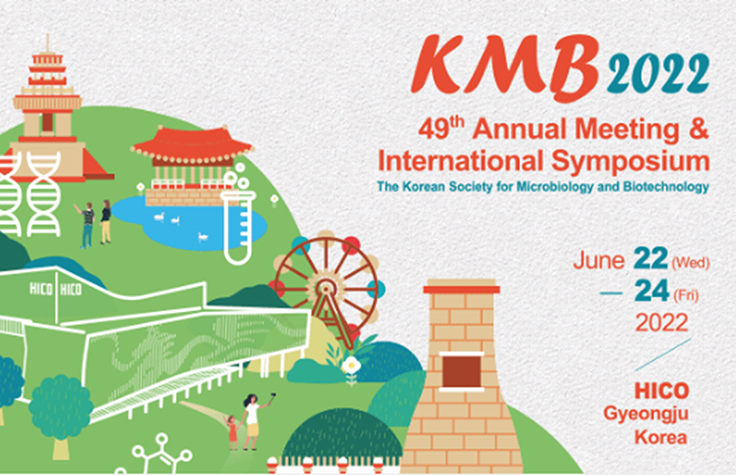
The Korean Society for Microbiology (KMB) will be held on Jun 22nd – 24th in HICO Gyeongju. Illumina will sponsor for luncheon seminar, booth, web magazine and homepage banner as gold sponsorship. Attend the Illumina Luncheon seminar from Donghyuk Kim from UNIST to learn about “Genomic and Transcriptomic Investigation of Transcriptional Regulation for Bacterial Pathogens”.
At the Illumina booth, we will exhibit NextSeq 2000 sequencing system (explore current and emerging applications with higher efficiency and fewer restraints) and how instrument helps your research and lab. Please visit Illumina Booth to learn more about.
* Lunch box will be provided.
Luncheon Seminar:
| Date & Time | Jun 23rd 11:55 AM ~ 1:00 PM ( 60min ) |
| Venue | HICO Kyungju Room 1 |
| Speaker | Donghyuk Kim (Associate professor, School of Energy and Chemical Engineering, UNIST) |
| Talk Title | Genomic and Transcriptomic Investigation of Transcriptional Regulation for Bacterial Pathogens |
| Abstract | Global transcription factors (TFs) have been studied extensively in the reference strain Escherichia coli K-12 MG1655 for the past few decades. However, conservation and possible diversity of regulons has not been experimentally investigated. With experimentally-derived pan-regulon definition for The highly conserved global Ferric uptake regulator (Fur), involved in iron homeostasis, is a highly conserved global TF with a large regulon. To study conservation and possible diversity of Fur regulons for multiple E. coli strains, we determined Fur binding sitesregulons in nine E. coli strains of different phylogroups with ChIP-exo and RNA-seq. Thirty-six of the 469 target genes (8%) found belong to the core regulon, comprising genes involved in ion transport/metabolism, energy production/conversion, and amino acid transport/metabolism. Another Other 158 target genes (34%) comprise the accessory regulon, most of which were related to cell wall structure/biogenesis, and virulence factor pathways. The remaining target genes (58%) were unique to each strain, with largely unknown gene functions. The pan-regulon is applied to 1) link strain-specific phenotypes (growth imparied, siderophore production, antibiotic resistance) to underlying molecular mechanisms; and 2) reveal that Fur has a disparate of target genes between the nine strains. Taken together, the Fur transcriptional regulation varies between the stainsin the same E. coli species, though the binding pattern is broadly conserved. We thus, for the first time, provide experimental evidence of the Fur pan-regulon that shows surprisingly high diversity in regulon genes amongst strains of the same species.treatments, recent advances in genetic testing, especially next generation sequencing technologies (NGS), have improved the genetic diagnosis of rare disease. There is no doubt that a positive genetic diagnosis could provide further information to aid clinical decisions and patient management. However, it should be addressed what sequencing method is the most efficient for identifying genes driving each rare disease. This talk is the first, to present an overview of genetic testing from Sanger sequencing to whole genome sequencing. Then, I review the pros and cons of each testing as a clinical testing. Finally, I would like to discuss the future direction of genetic testing. |
- Date & Time
- 22 Jun. 2022 – 24 Jun. 2022
- Location
- HICO Kyungju Korea
- Korea South
- Asia
- Topic
- Microbiology, Instruments