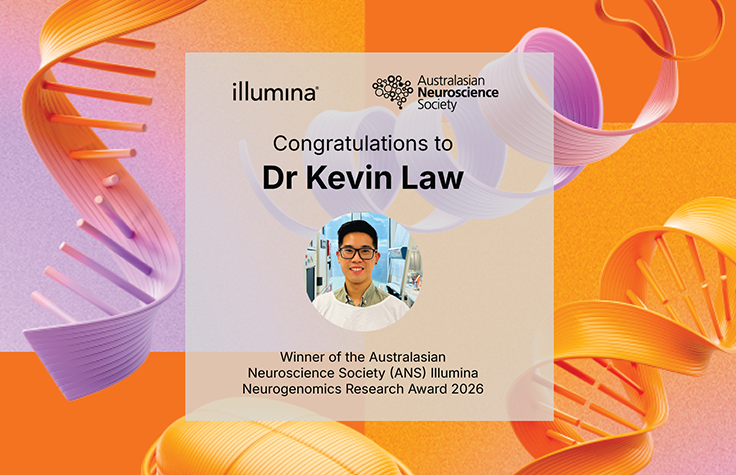
Multiomics research aims to advance understanding of the brain's breathing network.
Sydney, Australia, 27 November 2026
Dr Kevin Law, a research fellow at the University of Sydney's Charles Perkins Centre and School of Medical Sciences, has received the 2026 Australasian Neuroscience Society Illumina Neurogenomics Research Award for research investigating how the nerve cells involved in breathing develop and mature.
The brainstem plays a vital role in controlling breathing, but studying how it works in humans remains challenging. Dr Law uses human stem cells to grow brainstem organoids, or mini brainstems-in-a-dish, as a model to better understand how breathing-related nerve cells develop and function. His research aims to provide more human-relevant models for studying brainstem function and conditions that affect breathing.
His winning project, "Integrating multi-omics and electrophysiology to unravel maturation barrier in human respiratory brainstem organoids," will explore why some nerve cells can show electrical activity associated with breathing rhythms but are not yet mature.
The study will combine multiomics, which brings together different layers of biological information, with measurements of the cells' electrical activity. By examining how gene activity and DNA methylation influence nerve cell development, researchers hope to better understand what helps these cells mature.
"Breathing is fundamental to life, yet it remains one of the least understood physiological functions," said Dr Law. "It is controlled by the respiratory centre in the brainstem, the pre-Bötzinger complex, which cannot be accessed in living humans."
"We have established a respiratory brainstem organoid model and shown that it produces rhythmic bursts of electrical activity reflective of the breathing rhythm. Even though our organoids are active, the cells remain stuck in an immature state."
Susan Martin, General Manager for Illumina Australia and New Zealand, said: "The future of genomics is about bringing different pieces of biology together to see the bigger picture. Dr Law's project shows how this approach can help researchers explore areas of the brain that have been hard to study. We are proud to support his work through the ANS Illumina Neurogenomics Research Award and congratulate him and the University of Sydney team."
Dr Law and his colleagues will use Illumina Single Cell 3' RNA Prep and the Infinium™ MethylationEPIC v2.0 Kit alongside measurements of nerve cell electrical activity. By combining these results, the study aims to distinguish between cells that are still developing, cells whose development has stalled and cells that have reached a functionally mature state.
Dr Law added "By integrating single-cell gene expression with DNA methylation, Illumina's technology will enable us to study cell maturity and the underlying mechanisms driving maturation in organoids. Our multiomics work will help to design better human system models to study brainstem function and disorders that emerge throughout life."
Presented by the Australasian Neuroscience Society in collaboration with Illumina, the award supports neuroscience research using genomics and multiomics technologies. The winner is selected by a panel of ANS members based on the project's innovation, its capacity to inspire future research and its potential impact on neuroscience.
The research could help establish more human-relevant models for studying the brain's breathing network and conditions associated with disrupted breathing. The approach may also be applied to other lab-grown models of nerve tissue, supporting future neuroscience research.
To learn more, visit the Australasian Neuroscience Society Illumina Neurogenomics Research Award page.
For Research Use Only. Not for use in diagnostic procedures.
M-APAC-00036