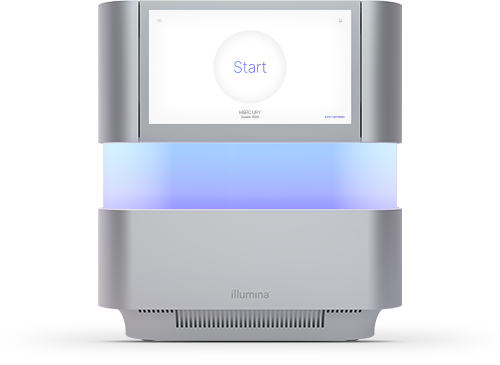
NextSeq 1000 and NextSeq 2000 System ordering
These sequencing systems offer expansive application breadth, operational simplicity, high flexibility and scalability, and proven performance.
Achieve cost-effective, accurate, and sensitive RNA exome analysis of even difficult samples without sacrificing gene fusion discovery power. Many RNA exome sequencing methods focus on a defined number of known transcripts or require expensive deep sequencing. RNA exome capture sequencing overcomes these challenges by combining RNA-Seq with exome enrichment.
This method captures only the coding regions of the transcriptome, allowing higher throughput and requiring lower sequencing depth than non-exome capture methods. Sequence-specific capture of the RNA exome does not rely on the presence of a poly-A tail. This makes RNA exome capture sequencing ideal for RNA-Seq with low-quality samples or limited starting material.
Isolating transcriptome coding regions maximizes discovery power at a fraction of the read depth of total RNA sequencing.

Illumina Distinguished Scientist Gary P. Schroth, PhD demonstrates advances in RNA-Seq technology. Learn how these RNA library prep methods allow transcriptome analysis from challenging samples, like single cells or FFPE tissues.
Illumina offers RNA exome capture workflows that simplify the entire process, from library preparation to data analysis and biological interpretation.
These sequencing systems offer expansive application breadth, operational simplicity, high flexibility and scalability, and proven performance.
A standalone kit allowing for ribosomal RNA and human globin mRNA removal in human, mouse, rat, and bacterial samples.
A fast, integrated workflow for producing enriched and indexed sequencing libraries from a broad range of sample types and RNA input quantities.
Explore genomics-based approaches to investigating cancer using NGS. Find tools to help you uncover novel insights into the biology of cancer.
Find NGS solutions to advance research on autoimmune diseases, heart disease, neurological disorders, psychiatric disorders, and more on a molecular level.
Each RNA-Seq experiment type—whether it’s gene expression profiling, targeted RNA expression, or small RNA analysis—has unique requirements for read length and depth. This article reviews experimental considerations and offers resources to help with study design.
User-friendly software tools simplify mRNA-Seq data analysis for biologists, regardless of bioinformatics experience.
Workflows for RNA sequencing guide
Learn about Illumina solutions for next-generation RNA sequencing applications.
Study cellular differences often masked by bulk sampling and explore highly sensitive single-cell sequencing methods.
Talk to an expert to learn more about RNA exome capture sequencing.